
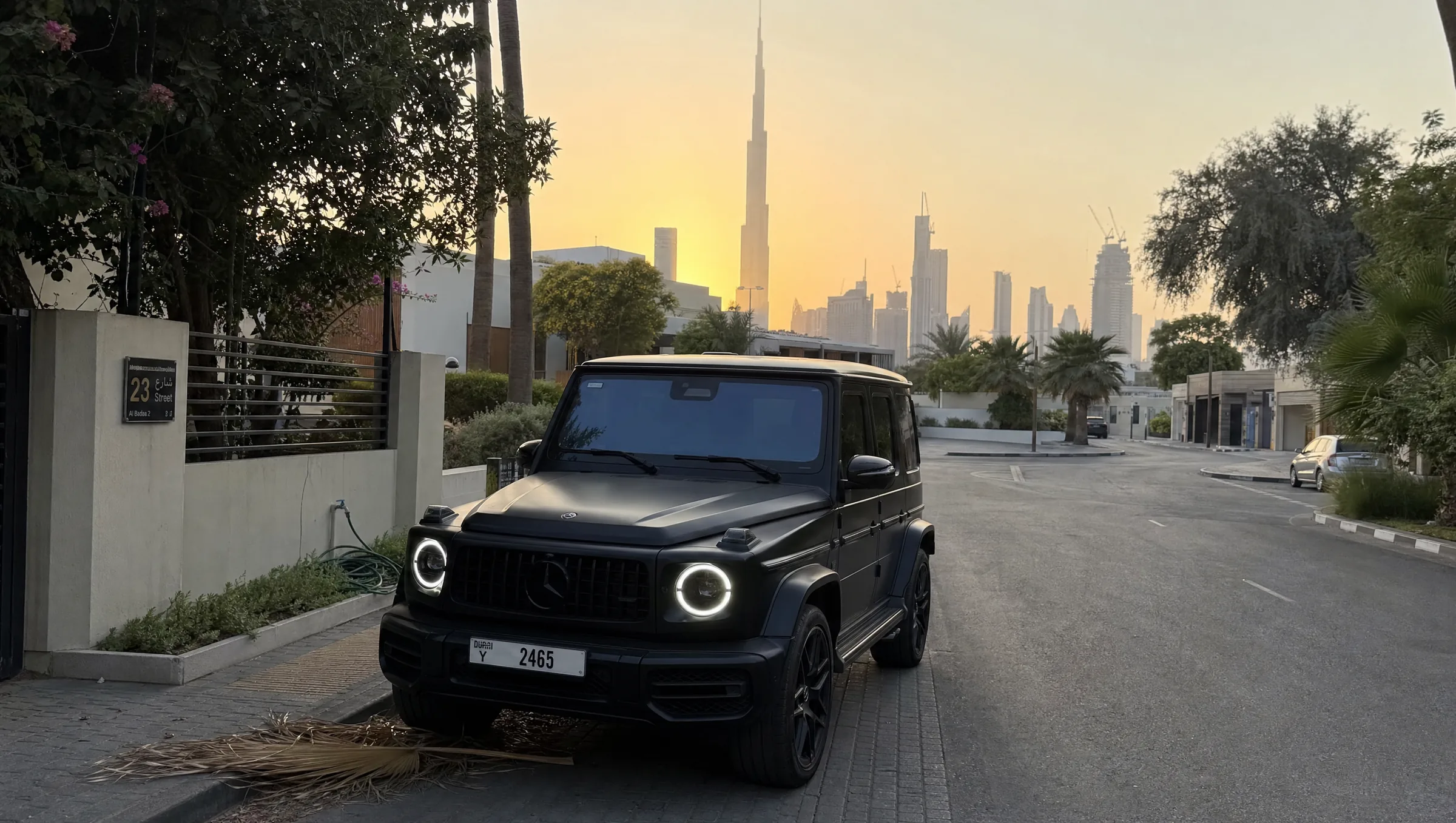
The UAE runs on premium metal, and Korea quietly holds the best-kept version of it, the same cars, in higher spec, for a lower number. The catch is that a Korean-market car is not a GCC-spec car, and that one fact decides how smooth the landing is. Here is the whole thing, Seoul dealer lot to Dubai plates, with the two UAE-specific things nobody spells out.
We ship to the Gulf most weeks. This is the honest version: why a UAE buyer looks to Korea, which cars are worth the freight, what it truly costs once Jebel Ali and the RTA are done with it, and where the GCC-spec step trips people up.
Why a UAE buyer looks to Korea
Dubai is not short of cars. What Korea gives you is a better example of the same car, on terms the local forecourt cannot match.
Higher spec for the money. The Korean premium buyer almost always orders the car fully loaded. Panoramic roof, nappa leather, premium audio, adaptive cruise, head-up display, the lot, even on trims that would be stripped back elsewhere. The same car in the same configuration costs meaningfully more bought locally.
Clean, honest history. Korea keeps tidy records. Lower average mileage, regular servicing, transparent repair history. A two-year-old car with 30,000 to 50,000 km is normal, not a find.
Odometer fraud is a crime, not a fine. Winding back the mileage in Korea is a criminal offence, not a slap on the wrist. That structurally shuts down the single most common used-car trick.
Left-hand drive, so it fits. Korea drives on the right, exactly like the UAE, so its cars are left-hand drive. No conversion, no workaround, none of the trouble that comes with a right-hand-drive Japanese or British import.
Deep supply of the premium and the exotic. Korea is a top-three market in the world for Rolls-Royce and Bentley, and its used lots are full of low-mileage German metal. If you want a specific colour, trim and year, Korea is where you can actually hold out for it.
For the full mechanics of how a car leaves Korea, read how to import a car from Korea. This guide is the UAE-specific layer on top.
The one thing to get right: GCC spec vs Korean spec
This is the UAE catch, and it is the whole reason to read this before you buy. A car sold new in Korea is built to Korean spec, not GCC spec. It is the same car mechanically, but for UAE road use it has to be proven to meet Gulf standards before it can be plated.
In practice that means one extra document: a GCC Conformity Certificate from MoIAT (the Ministry of Industry and Advanced Technology), which a non-GCC car needs before the RTA will register it. It is a step, not a wall. It adds a little time and a little cost, and occasionally a check on cooling or emissions equipment, but for a normal premium car it is a process you move through, not a reason the car cannot come.
Two honest points that come with it:
- Heat. Korea gets hot summers and cold winters, so its cars carry proper climate hardware, strong air-conditioning, cooled seats on premium trims. The Gulf heat is still a fair question, so on inspection we check the cooling and the AC on the exact car, and flag anything before you commit.
- Warranty. A non-GCC car may not be covered by the local GCC dealer warranty network, because that coverage is often regional. If the specific car still has manufacturer warranty, we check that brand's policy on the exact candidate. We do not promise a transfer, we tell you what is true for that car.
None of this is a surprise if you know it going in. The mistake is finding out at the RTA, not before you paid.
Which cars are worth bringing to the UAE
UAE demand skews hard to the top of the range, and that is exactly where Korea is strongest.
The German premium trio
Mercedes-Benz (the AMG G63 above all, plus GLE, GLS, S-Class), BMW (X5, X6, X7, the M cars), Audi (Q7, Q8, RS family). These arrive in Korea from the same German and US factories that build the European cars, carry a Korean VIN, and are the identical vehicle. Korean lots often hold them in very high spec because the local buyer does not save on options.
Korean luxury
Genesis G80, G90, GV80, GV70, and the loaded Hyundai and Kia flagships (Palisade, Carnival, the big Genesis SUVs). Best value-to-spec of anything on the list, easiest to find in the exact configuration, and quick to inspect and buy.
The exotic
Rolls-Royce Cullinan, Bentley Bentayga and Continental, Porsche Cayenne, Panamera and 911. These turn up on the Korean market with very low mileage and in near-perfect condition. Longer to source, worth the wait, and the category where a Korea visit to see the car in person makes the most sense.
For the picks and their real Korean-market prices, see the best cars to import from Korea, or browse the full catalog.
How you choose the car
The selection runs the same way for every car, and only the first step is one you can genuinely do alone.
- Brief. Make, model, year, mileage ceiling, must-have options, colours inside and out, budget. The tighter the brief, the faster and more predictable the search.
- Search. Most cars start on Encar, Korea's largest listing site, with dealer inventory and auctions on top. Found one yourself? Send the link and we take that exact car into the process.
- Inspect. On every candidate we go to the car in person: body and paint with a thickness gauge, an OBD diagnostic on engine and gearbox, and an interior check for flood and wear. Photos and video on each, sent to you before you pay the balance. See how we inspect.
- Approve and buy. You review the inspection, approve the exact car, pay the balance, and we buy it in your name from the Korean dealer.
What it costs to land in the UAE
The UAE side is one of the lighter tax stacks in the world, which is a large part of why importing here works. Two taxes plus a handful of fees, layered on the value that arrives at the port.
- Customs duty: 5% of the CIF value (the car cost plus insurance plus freight). As of 2026, verify.
- VAT: 5%, charged on the duty-inclusive value, so it lands on (CIF + duty). That makes the two together roughly a 10.25% effective rate, not a flat 10%. As of 2026, verify.
- Then the fees: shipping, marine insurance, the GCC Conformity Certificate, the RTA inspection, registration and plates. All-in, the extras over the Korean purchase price usually land somewhere around 13% to 18%, depending on the car and the week.
Here is the shape of the bill on a real example, a 2025 Mercedes-AMG G63 we sourced recently with about 6,000 km for roughly $196,000 in Korea. Every figure moves with the market and the exact car, so read it as the structure, not a quote.
| Line | Rough figure | Note |
|---|---|---|
| Car in Korea | ~$196,000 | Real recent example, 2025 G63, ~6,000 km |
| Sea freight to Jebel Ali | ~$1,800 to $2,800 | Container, route and week dependent |
| Marine insurance | ~$2,000 to $2,500 | All Risks, on landed value |
| UAE customs duty (5%) | ~$10,000 | Of CIF value. As of 2026, verify |
| UAE VAT (5%) | ~$10,500 | On duty-inclusive value. As of 2026, verify |
| Conformity, RTA test, registration, plates | ~$1,500 to $3,000 | Higher for a non-GCC car |
Illustrative only, for the UAE, as of 2026. Duty and VAT rates and fees change, so we give you a full open-book breakdown for your exact car before you commit a cent. The same percentages scale down to a Genesis GV80 or a Cayenne just as they scale up to a Cullinan.
How long it takes, Korea to Dubai plates
The Gulf is the fastest route we run, because it is the shortest sea leg from Korea. Door to plates is usually about four to six weeks, and the ocean is the biggest single piece.
| Stage | Rough time |
|---|---|
| Sourcing and inspection | ~1 to 2 weeks |
| Purchase, deregistration, export clearance, loading | ~10 days |
| Sea transit to Jebel Ali | ~2 to 2.5 weeks |
| Customs clearance at Jebel Ali | ~2 to 4 days (1 to 2 weeks if non-GCC conformity is being processed) |
| RTA inspection and registration | a few days |
Registering the car in the UAE, step by step
Once the car lands at Jebel Ali, the UAE side runs in a fixed order. Most of it is handled for you, but it helps to know the sequence.
- Customs clearance at the port, where the duty and VAT are assessed on the CIF value and paid.
- Vehicle Clearance Certificate (VCC) issued once customs is cleared, the document that says the car entered the country legally.
- MoIAT GCC conformity for a non-GCC car, the certificate that proves it meets Gulf standards. This is the Korean-spec step.
- RTA inspection at an approved centre (Tasjeel or Shamil): a visual check, emissions, and mechanical safety.
- Insurance, which you must have in place before the car can be registered.
- RTA registration, which issues the Mulkiya (the registration card) and the plates. The car is now road-legal.
The documents that travel with the car
From the Korea side, the car ships with its paperwork so the UAE side has what it needs:
- Export deregistration certificate (the car cancelled at origin)
- Export declaration and confirmation from Korea Customs
- Commercial invoice
- Packing list
- Bill of lading (the sea waybill)
- Certificate of origin
The mistakes that cost UAE buyers real money
- Ignoring the age rule. The UAE generally restricts used imports to under about ten years old, with older cars needing pre-approval. Check the car's age against the rule before you fall for it. As of 2026, verify.
- Assuming a GCC warranty. A non-GCC car may not be covered by the local dealer network. Budget and plan as if it is not, and treat any remaining coverage as a bonus we confirm on the specific car.
- Forgetting the conformity step. The MoIAT certificate is not optional for a non-GCC car. Skip it in your planning and the timeline and cost both surprise you at the port.
- Hidden fees. A price is agreed, then vague "handling" and "management" charges appear at the end. Insist on the numbers in the open from the start.
- Budgeting only the car. The taxes are light here, but shipping, conformity, inspection and registration still stack. Price the landed cost, not the Korean sticker.
Can you do this yourself?
Part of it, yes. You can browse Encar and pick cars all day. But the export out of Korea is closed to a private foreign buyer: only a registered Korean business with a customs clearance code can file it, so the deregistration, the customs declaration, the loading window and the shipping all run through someone on the ground. And the two places a solo buyer gets burned, verifying a car's real condition from the other side of the world and wiring a large sum to a stranger, are exactly the two places an agent earns their keep.
That is what we do. You tell us the car, we find it and inspect the exact one before you pay, we handle the deregistration, export and shipping to Jebel Ali, and we give you the whole cost in the open. Read how our process works, or just tell us the car you want and we will come back with real options.