
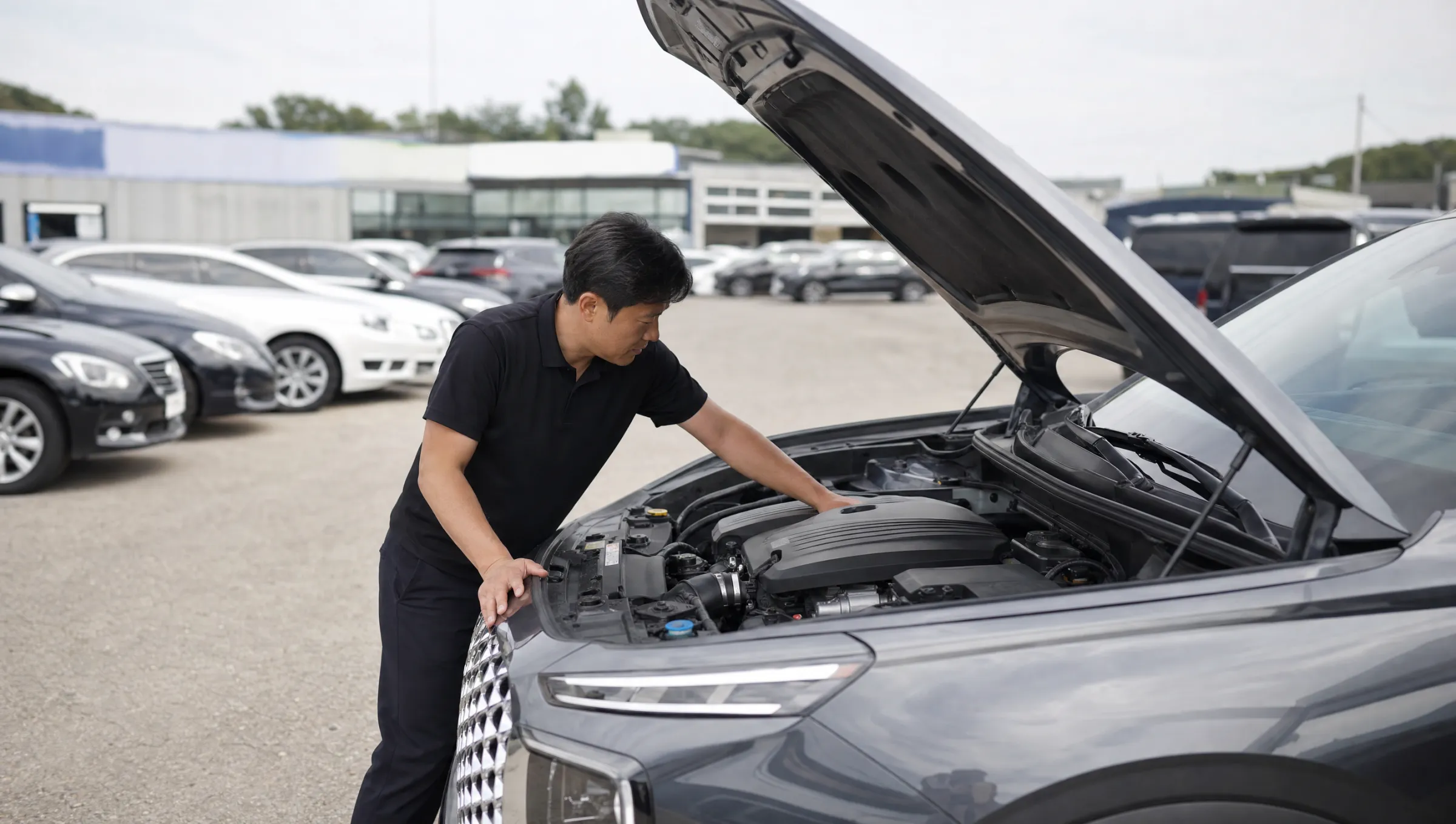
Yes, buying a car from Korea is safe. The country runs one of the most transparent used-car markets in the world, with mandatory history records and a graded auction system. The risk was never Korea. The risk is the person you wire your money to.
Almost every horror story comes down to one thing: paying someone you could not verify. So the useful question is not "is it safe," it is "how do I not get cheated." Every guide online lists the scams and tells you to demand proof. Almost none of them show you what real proof looks like. We will, including our own, so you can check us the same way we are telling you to check everyone else.
The scams, named
They fall into three groups.
The money scams
- Wire and disappear. A great price, pressure to pay fast, a personal bank account, and once the money lands, silence. This is the big one.
- Cars that do not exist. A fake or stolen-photo listing for a car nobody actually has, built to collect a deposit.
The car scams
- Bait and switch. The car you approved is not the car that gets shipped.
- Odometer rollback. The mileage on the dash is not the mileage the car has done.
- Hidden accident damage. A repaired crash sold as "accident-free," usually covered by a full respray.
- Flood damage. A car drowned in Korea's summer monsoon, dried out and sold on. It ruins the electrics.
- Forged documents. Faked history reports, faked inspection papers, a washed title.
The fee scams
- Hidden fees. A price is agreed, then vague "dealer costs" and "management fees" appear on the final bill.
- Inflated shipping. A padded freight quote with a margin buried inside it.
And the good ones are convincing. The strongest scams steal a real company's registration details, and even its contracts, so the paperwork looks perfect. They send a photo of a "director" holding a passport. They forward you a video of your car being inspected abroad. None of it is proof. A registration can be borrowed, a contract copied, a review bought, and that inspection video is often just a clip the scammer asked the real seller to send. Perfect paperwork is not the same as a real company.
The red flags
You can spot almost all of it before you pay. Walk away if you see these.
- A price well below the market. Real Korean prices are not half of everyone else's, so a number that good is bait.
- Pressure to pay right now, or a discount for paying everything upfront.
- Payment asked to a personal bank account, never a company one.
- No verifiable Korean business registration number, no real address, no phone.
- Refuses a live, dated video of the actual car, or refuses an inspection.
- Stock or watermarked photos instead of the real car.
- No reviews, no references, a brand-new website with no history.
- Wants your money before there is any inspection or signed contract.
How to protect yourself
Three checks, in order. Do them and the risk mostly disappears.
Verify the seller
- Check the business registration number, then dig deeper. A real exporter is a registered company with a ten-digit business registration number you can verify on the National Tax Service portal (Hometax). But details get stolen, scammers borrow a real company's number and address, so confirm the business at that address actually imports cars, not parts, look for years of real history, and where you can, deal with someone you can meet.
- Confirm a real office and real reviews. A physical address you can find on a map, and reviews or references from buyers in your own region that you actually contact.
- Only ever pay a company account. The bank account must be the registered business, in the company's name. A personal account is the single clearest sign to stop.
Verify the car
- Pull its history. Korea keeps proper records. A KIDI report (from the Korea Insurance Development Institute) shows accident, insurance, flood and mileage history against the car's own number. We cover exactly how to read one in our guide to checking a Korean car's history.
- Insist on live proof, not a forwarded clip. A common trick is for a scammer to email the real seller for a few photos or a video and forward it to you as if they inspected the car themselves. What you want is your own independent inspector at the exact car, or a live video call where they answer in the moment: start the engine, turn the wheel, read out today's date, show the VIN now.
- Insist on a real in-person inspection of the exact car before the balance moves. A listing, even a good one, is never proof of condition.
Verify the money
- Watch the account to the very end. A classic move is to switch the bank details at the last moment to a personal account or a "representative," with a power of attorney as the excuse. If the account is not the company's own, stop.
- Never pay 100% upfront. A deposit to hold the car, the balance only after you have seen the inspection and the car is loaded.
- Get it in writing. A contract that names the car, its condition and mileage, and what happens if any of it turns out to be false.
What real proof looks like
Here is the part the other guides leave out. It is easy to say "demand an inspection." It is another thing to show what one actually catches.
Take the paint scan. A paint-thickness gauge tells you if any panel has ever been resprayed, which is how you catch a repaired crash hiding under "accident-free" paperwork. Factory paint sits between about 80 and 130 microns. A repaint reads double, sometimes triple, and the gauge shows it in seconds. It turns a "trust the dealer's word" moment into a "verify in five minutes" moment.
We have walked away from cars over exactly this. A dealer listed one as original paint, accident-free; the gauge read high across half the panels, a full respray, and when we pushed, the dealer kept denying it. We walked. Another time the car was too filthy to read, and when our inspector asked for a five-minute wash to get a clean number, the dealer said look at it like that or get lost. So we got lost. A paint number you cannot trust is not a number, it is a guess, and we do not put guesses in front of a buyer. If a seller will not let you verify the car, that refusal is your answer.
That is why our inspection is four parts on the exact car: a full visual walk-around, a computer diagnostic that reads fault codes and odometer tampering, the paint gauge across every panel, and the interior on video to rule out flood. You get the whole thing, photos and video, before the balance is ever paid. Do not take our word for it, ask us for a real sample. We will send you the full inspection folder from a car we actually sourced, so you can see the standard before you ever engage us.
Now verify us
Everything above says to check the exporter before you trust them. So check us. AJ Trading is a Korean-registered company, business registration number 884-81-03078. You can look it up yourself, the same way we told you to look up anyone else, and the full registration extract is on our about page. An exporter who will not show you this is the one to worry about.
And if you want proof you can stand on, come to Korea. We will host you, and source and inspect the car together, in person. The firms to fear are the ones you can never meet. We are the opposite.
If it goes wrong anyway
If you have already sent money and something feels off, move fast. Call your bank immediately and ask about a wire recall, the first hours matter most. Keep every message and receipt. A fraud involving a Korean seller can be reported to the Korea Consumer Agency and the police, and a legitimate agent on the ground can help you chase it. The best protection, though, is the one you do before you pay, not after.
So, do you need an agent?
Not to skip the checks. Because a real agent is the checks. Everything on this page, verifying the seller, pulling the history, inspecting the exact car, holding it with a deposit instead of paying in full, paying only a company account, is what a buying agent does for a living. That is what we do. You can read how our process works, or just tell us the car you want and we will come back with real options, inspection and all.