
Importing a car from Korea is not hard. It is just a lot of small steps, and two of them decide everything: whether your country will even let the car in, and what it truly costs once it lands. Every guide online walks the steps and then goes quiet at exactly those two points.
We do this most weeks, so here is the whole thing, start to finish, with the parts nobody prints: the real documents, the real costs, the country-by-country catch, and an honest answer on where you can do this yourself and where you should not.
First, before you fall for a car: will your country take it?
This is the single most expensive mistake we see. People find the perfect car, pay for it, ship it, and only then learn it cannot be registered at home. Check these two things before anything else.
- Which side does your country drive on? Korea drives on the right, so Korean cars are left-hand drive. That is perfect for the Gulf, Central Asia and continental Europe, which want left-hand drive. It is a wall for the countries that require right-hand drive to register, like Kenya, the UK and Australia. If you are in a right-hand-drive market, Korea is usually the wrong place to buy.
- How old is too old for your rules? Many countries cap the age of an imported car, and the number is all over the map. Some want it under a few years, some under ten, some tax it harder the older it gets. Age can decide whether the car is allowed in at all, and how much tax you pay on it. More on this in the country sheet below.
There is a third layer under those two: homologation. The honest truth is that most cars can be imported almost anywhere. The real question is whether it makes sense once you add everything up. Some markets want the car to meet a local emissions standard, some make you homologate it, sending the car's full specification to the manufacturer or an approval body and waiting for a certificate before you can register, and every market has its own list of documents you must hand over to get plates. None of that is usually a hard stop, it is cost and time. So the real question is rarely can I import this car, it is does it make sense to, once the rules and the bill are on the table. We do that math with you before you buy.
The process, step by step
Step 1. Find the car
Most cars start on Encar, Korea's largest listing site, or come from dealer inventory and domestic auctions. A listing is a starting point, not a purchase. Prices and photos tell you a car exists, they do not tell you its real condition or history. This is the easy part, and the one part a buyer abroad can genuinely do alone.
Step 2. Inspect and verify
This is where buying from abroad goes wrong or goes right. Before any money moves on a specific car, it should be inspected in person and its history pulled. Two things matter most in Korea: a physical inspection (body and paint, engine and drivetrain, frame, electronics, interior for flood signs) and the car's history report from the KIDI, the Korea Insurance Development Institute, which shows accident, insurance, flood and mileage records.
If you know how to read an Encar listing you can already tell a lot from it, whether the car carries an accident record, whether panels have been repainted. But a listing can never make you completely sure, which is why the exact car still gets a real in-person inspection. In practice you arrange that inspection with the dealer, and place a holding deposit so the car is not sold to someone else while it is being checked.
Step 3. Agree and pay
Once you have approved the exact car, you confirm the price and pay. The safe structure is a deposit to start and the balance only after you have seen the inspection. Payment is usually by bank transfer. Ask for the price broken out in the open, the car, the shipping, the fees, so you can see what you are paying for.
Two things to expect here. Almost every Korean seller is a local dealer who speaks little English, and the whole country does business on KakaoTalk, Korea's version of WhatsApp, so you are negotiating in Korean on an app you have probably never used. And watch for lease cars: a lot of Korean cars are still on a finance lease, and to buy one it has to be taken off the lease first, which means a penalty of about 3.5% of the car's value and a couple of weeks of waiting while the lease is cleared.
Step 4. Deregister and clear the car for export
Here is the part the online guides skip, and the part a private foreign buyer cannot legally do alone. To export a used car out of Korea:
- The exporter must be a registered Korean business with a customs clearance code. A private individual abroad cannot file the export. This alone is why almost everyone works through a Korean exporter or buying agent.
- The car must be deregistered first. Korean law (the Motor Vehicle Management Act) requires any used car to be officially deregistered at a vehicle registration office before it can be cleared for export. This is an anti-theft control, and the deregistration certificate is the document your own country will want to see to prove the car was cancelled at origin.
- A customs declaration is filed with the Korea Customs Service, and once it is accepted the car must be loaded onto a vessel within 30 days. Miss the window and the declaration lapses.
- Brand-new cars are effectively off the table. A zero-mile car is very hard to export, because Korean dealers who sell a new car to an unauthorised exporter can have their franchise pulled and the warranty voided by the manufacturer. So the market is used and lightly-used cars, which is what you want anyway for the price.
The paperwork that travels with the car: the export deregistration certificate, the export declaration and confirmation, the commercial invoice, the packing list, and the bill of lading, plus a certificate of origin or conformity where your market needs one.
Step 5. Package and ship
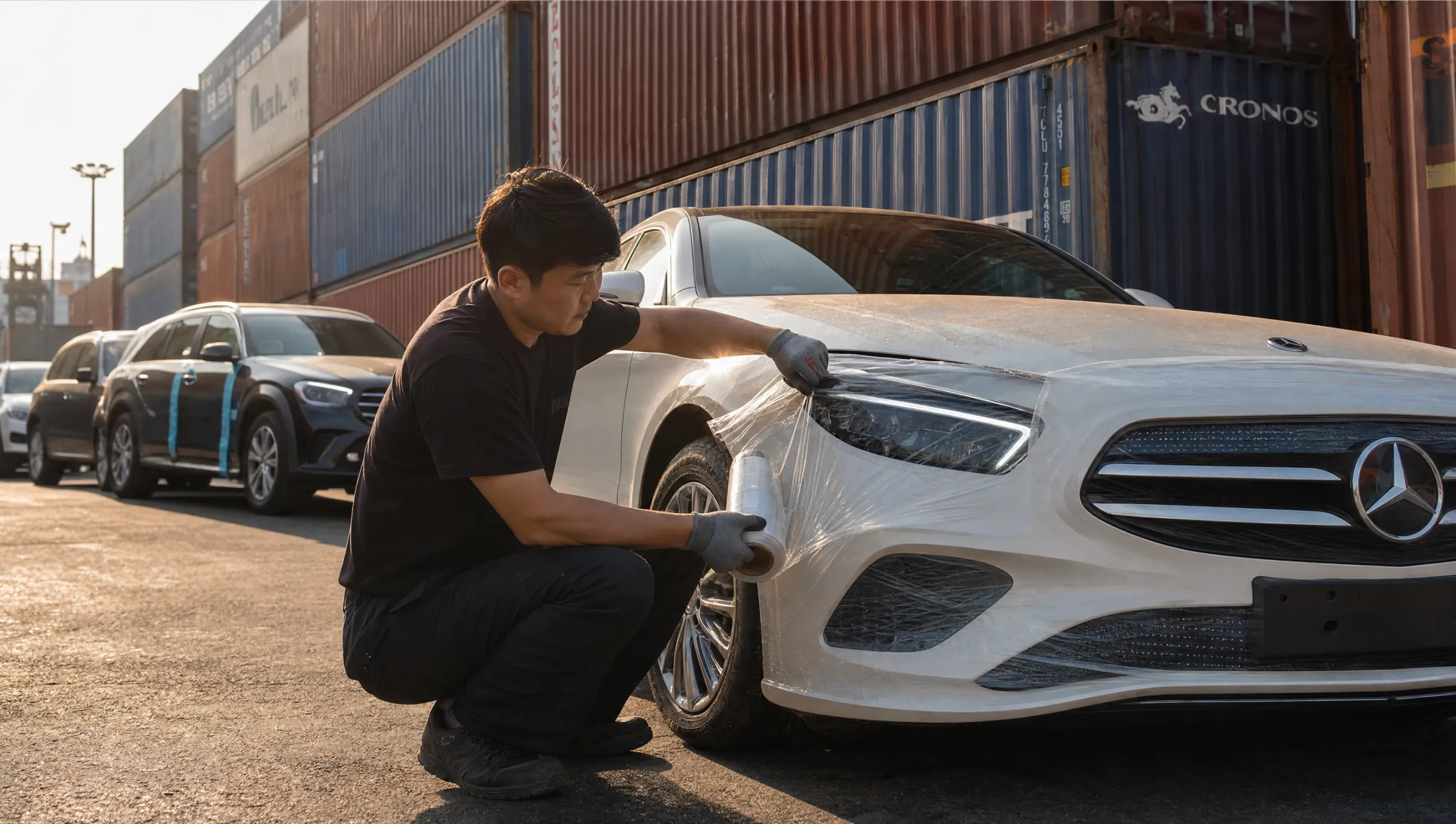
A car crossing an ocean for weeks needs to arrive the way it left. Done properly, that means the paint is wrapped in protective film, moisture-absorbing bags go inside the cabin so the sea air does not grow mould on the interior, and the car is sealed into a container. You have two ways to ship:
- RoRo (roll-on, roll-off): the car is driven onto a dedicated car ship. Cheaper, frequent sailings, fine for mainstream cars. It rides in the open, and you cannot pack anything with it.
- Container: the car is strapped and sealed inside its own container. It costs more, but it is enclosed, protected, and the right choice for a premium car. We ship through Incheon.
Insure the car for the voyage on an All Risks marine policy at the full landed value (the standard is the value plus ten percent). Do not accept a total-loss-only policy on a car worth real money. As a rough guide, sea transit runs about two to two and a half weeks to the Gulf, five to seven weeks to Europe, and longer to East Africa and Central Asia. These move with the route and the season, so treat them as ranges. And if you need the car fast, or it is valuable enough to justify it, it can go by air instead. Air freight costs several times the sea rate, but it turns weeks into days.
Step 6. Clear customs and pay the taxes at your end
When the car lands, your own country's taxes come due, and this is the number people underestimate. Almost everywhere charges some mix of import duty, VAT, and sometimes an excise or recycling fee, layered on top of each other. On some routes that stack adds a little; on others it can add half the car's value again. Know your country's numbers before you buy, not after. The country sheet below is the starting point.
One extra wrinkle if your country has no coast: the container sails to the nearest port and the car comes overland from there. For Switzerland, for example, the box lands at Bremerhaven in Germany and the car travels on a T1 transit, so the duty is not charged in Germany, it is paid at home in Switzerland instead.
Step 7. Register the car
Last, the car has to be made road-legal at home: any local inspection or compliance check, then registration and plates. This is light in markets like the Gulf and Central Asia, and heavier in places like the EU, where a Korean-market car that was never sold in Europe cannot get a standard certificate of conformity and needs an individual approval instead. That certificate is a small project of its own: you send the car's full specification to the manufacturer's headquarters or an approval body and wait for them to grant it, and only then can you register.
What it actually costs
Nobody prints this, so here is an illustrative example, a mid-spec Genesis GV80 landed in the UAE. Every figure moves with the market, the exchange rate and your exact car, so treat it as the shape of the bill, not a quote.
| Line | Rough figure | Note |
|---|---|---|
| Car in Korea | ~$31,000 | Encar market price for the model |
| Sea freight to Jebel Ali | ~$1,500 to $2,500 | Container, route-dependent |
| Marine insurance | ~$400 | All Risks, on landed value |
| UAE customs duty | ~5% of value | As of 2026, verify |
| UAE VAT | ~5% | As of 2026, verify |
| Clearing, registration, plates | ~$1,000 | Varies |
Illustrative only, for the UAE, as of 2026. Duty and VAT rates and fees change and differ by market, so we give you a full open-book breakdown for your exact car and country before you commit a cent.
The country catch sheet
Every destination forks on the same five things: steering side, age limit, emissions or spec rules, the tax stack, and how hard it is to register on arrival. Here is the short version for the markets we ship to most. These rules change often, so verify for your exact country, we check it for you before you buy.
| Market | Korea fit | Age | Taxes (verify) | The catch |
|---|---|---|---|---|
| UAE / GCC | Good (needs LHD) | ~10 years | ~5% duty + 5% VAT | GCC-spec expected; via Jebel Ali |
| Kazakhstan / CIS | Excellent (LHD) | Age-taxed | Duty scaled by age and engine size, plus recycling fee | 2 to 4 year cars are the sweet spot; EVs often lighter |
| Europe (EU) | Good (LHD) | Emissions-led | ~10% duty + local VAT | No standard EU conformity, needs individual approval |
| Kenya / East Africa | Poor (needs RHD) | ~8 years (2019+) | Duty + excise + VAT stack | Right-hand-drive market, Korean LHD usually cannot register |
| Australia | Poor (needs RHD) | Strict | Duty + GST + compliance | Right-hand-drive; conversion usually uneconomic |
How long it takes
Door to registration is usually six to twelve weeks, and the ocean is most of it. Shipping times also swing with the geopolitical situation, a closed route or a congested canal can add weeks.
| Stage | Rough time |
|---|---|
| Sourcing and inspection | ~1 to 2 weeks |
| Purchase and payment | a few days |
| Deregistration, export clearance, loading | ~1 week |
| Sea transit | ~2 to 7 weeks by route |
| Customs at destination | a few days to over a week |
| Registration | days to weeks by country |
The mistakes that cost people real money
- Buying a car they cannot register. The right-hand-drive mismatch and the age-limit miss are the two big ones. Check both before you pay.
- Trusting the odometer. Rollback is not common, but it happens, and a KIDI history report catches it. So do the flood cars that come out of Korea's summer monsoon.
- Hidden fees. A price is agreed, then vague "dealer costs" and "management fees" appear on the final bill. Insist on the numbers in the open from the start.
- Paying an exporter you cannot verify. Non-delivery and fake escrow are the common frauds. Be very suspicious of anyone asking you to wire money to a personal bank account, pay only into the company's registered business account.
- Budgeting only the car. The duty, VAT and fees at your end can add a large share on top. Price the landed cost, not the sticker.
Can you do this yourself?
Honestly, part of it yes, part of it no. You can browse Encar and pick cars all day. But the export itself is closed to you: only a registered Korean business with a customs clearance code can file it, so the deregistration, the customs declaration, the loading window and the shipping all run through someone on the ground. And the two places a solo buyer gets burned, verifying a car's real condition from the other side of the world, and wiring a large sum to a stranger, are exactly the two places an agent earns their keep.
That is what we do. You tell us the car, we find it and inspect the exact one before you pay, we handle the deregistration, export and shipping, and we give you the whole cost in the open. Read how our process works, or just tell us the car you want and we will come back with real options.