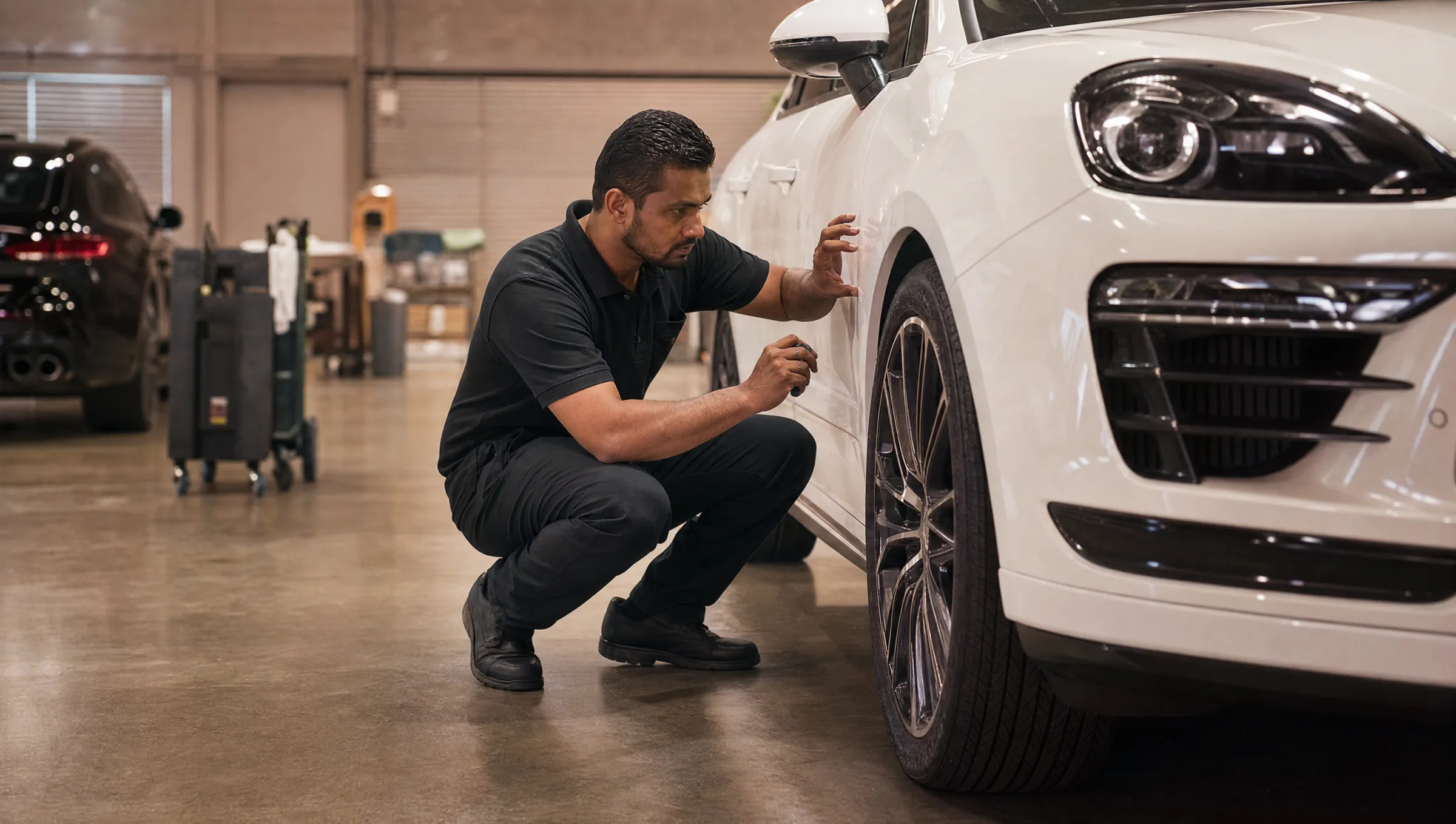
Two records tell you a Korean car's past: the insurance history and the dealer's condition sheet. Both are worth having. Neither of them walked around the car. They know about the accidents that went through insurance, not the chip on the hood, the fender that was quietly resprayed, or the dent someone paid cash to fix.
For that, someone has to stand next to the car and look. So on every car we source, one of our own inspectors goes to it in Korea and runs the same four-part check. It takes a couple of hours and it is not glamorous. It is just thorough. Here is the whole thing, start to finish.
We start at the hood and work all the way around the car. On each panel we are reading three things: the gaps between it and the next panel, whether the colour matches from one panel to the next, and every chip, scratch and dent. Small things give the game away. A little dust trapped under the paint on one fender usually means someone did a local respray there. A bumper that sits a shade off the wing next to it has been off the car at some point.
Then it is the details, all the way round. The wheels, how much tread is left and whether the rims are kerbed. The lights, for a hairline scratch or fogging inside the lens. The glass and mirrors. The protective film along the door edges. And underneath, along the sills and the floor. Every panel gets looked at from a few angles, because a dent only shows itself in the right light.
Then we go over the whole car with a paint-thickness gauge. Factory paint sits at around a hundred microns. A panel that has been resprayed reads much thicker, often double, and that is how you catch a repair nobody wrote down. We take readings on every panel, both pillars, the roof and every door. Most of the time the numbers come back factory and consistent, and that is a good car. Sometimes one panel reads high on its own, a local respray, and that becomes a straight question to the dealer about what happened to it.
This is the step we will walk away from a car over. We once came to see one listed as original paint and accident-free, and the gauge read high across half the panels, a full respray hiding a repaired crash. The dealer kept denying it, so we left. Another time the car was too filthy to read properly, and when our inspector asked for a quick wash to get a clean number, the dealer told him to look at it like that or get lost. So we got lost. A paint reading you cannot trust is not a reading, it is a guess, and we do not hand a buyer guesses.
Korea gets a heavy summer monsoon, and every year some flooded cars get dried out and put back on the market. So the interior check starts with the nose. We lift the floor mats and check underneath for damp and a musty smell, look over the wiring, and pull the seatbelts all the way out to look for waterlines high up on the webbing. Flood damage hides in the fabric and the electronics, and this is where it shows.
After that it is the ordinary wear, read against the mileage the car claims. The seats, the steering wheel, the buttons, the pedals, the boot. A wheel worn smooth and a shiny seat bolster on a car showing thirty thousand kilometres do not add up, and that mismatch is often the first sign the odometer has been wound back.
Last, we start it. The steering should turn without noise or play, so we listen for both. We rev the engine out to make sure it pulls cleanly all the way up. We work through the gearbox, up and down, listening for a knock or a kick on the changes. Then we open the hood: the frame rails for any sign of a past impact, the sealant to check it is factory and has not been disturbed, and the turbo, which should be dry with no oil weeping out of it.
At the end, the inspector writes it all up, every defect found, and you get the whole record: the photos and the video of your actual car, so you are looking at exactly what we are looking at, and you approve that specific car before the balance is paid. If none of the first cars is right, the search keeps going and the next one gets the same treatment.
And you do not have to take our word for any of this. Ask us for a sample and we will send you a real inspection folder from a car we have already done, so you can see the standard for yourself before you ever work with us.
Because the records only ever knew about the accidents that went through insurance. The chip on the hood, the fender someone resprayed, the dent that was fixed in cash, none of that is written down anywhere. It only turns up when someone stands next to the car and checks. That is the part you cannot do from the other side of the world, and it is the part we do on every car.
See how the whole process works, or tell us the car you want and we will find it and inspect it.
Send us the car you want, or a budget and a model. We find it on the Korean market and put it through the full four-part inspection, and you see the whole report before you decide.
Get in touch