
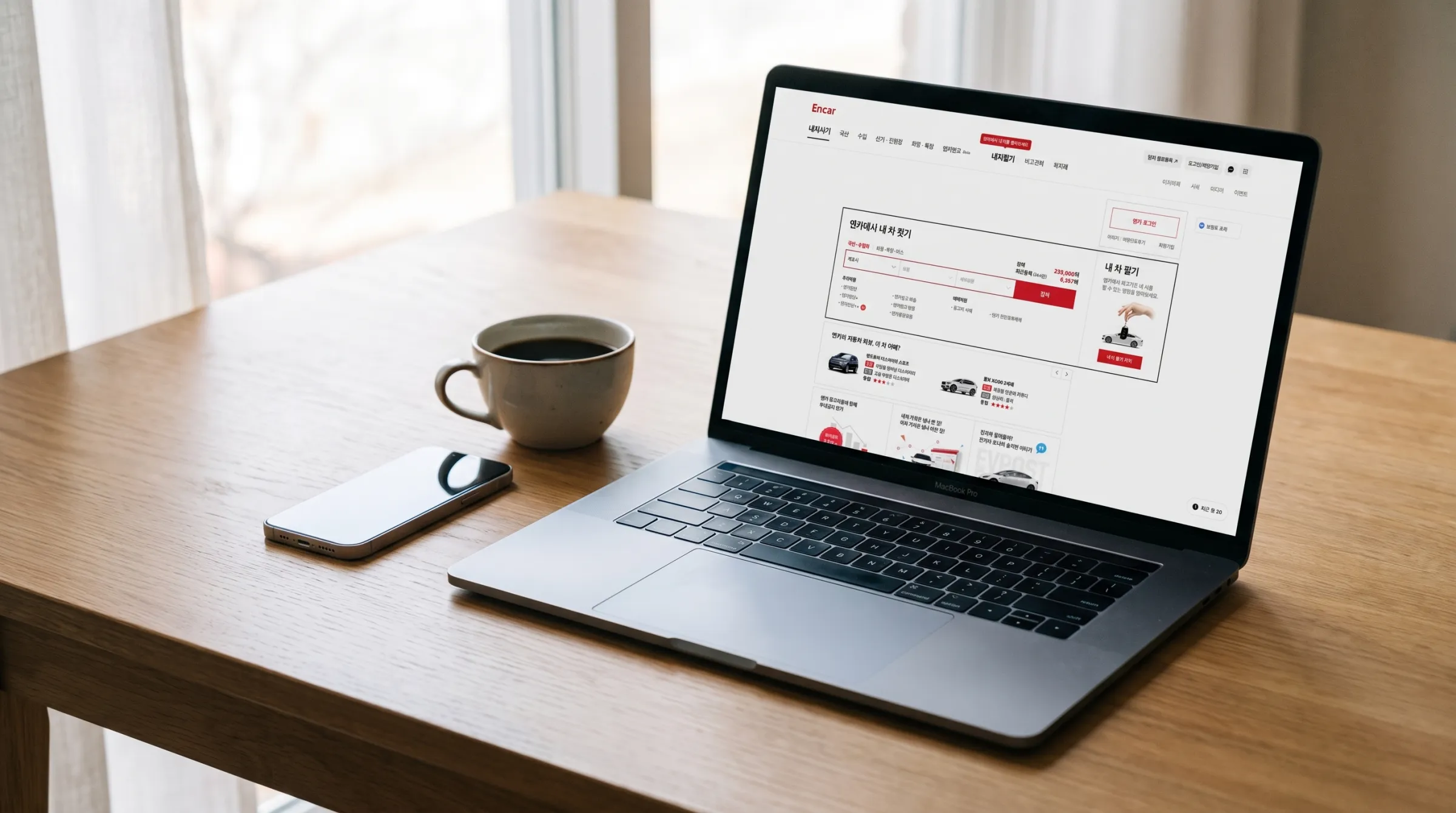
Sooner or later, everyone importing a car from Korea ends up on Encar. It is the country's biggest used-car market, hundreds of thousands of cars, and it is the right place to look. Then comes the part nobody warns you about: you find the perfect car, and you cannot actually buy it.
So here is the honest version. How to use Encar properly to find and read a real car, the tells that separate a good listing from a trap, and the plain reason the buy button does not work for someone sitting abroad, plus what to do about it.
What Encar is
Encar (encar.com) is Korea's number-one used-car marketplace, mostly cars listed by dealers, some by private owners. Its real strength is that a listing pulls the car's accident and insurance record straight from Korea's databases, so a crash from years ago, anywhere in the country, shows up on the page. It is the best place in the world to find a Korean car. It is not a place a foreigner can check out of.
How to read an Encar listing
A listing is only useful if you can read what it is actually telling you. The important parts:
- Price is in 만원, which means times ten thousand won. A listing at "7,800만원" is 78,000,000 won. Learn the rough figure for your model, because a price well under it is the first sign of a battered or misdescribed car, not a bargain.
- The listed year is the registration date, not the build date. A car can be built a few months before it is first registered, which matters a lot if your country has an age limit. Do not trust the headline year on its own.
- Buy from a dealer, not a private seller. Encar lets you filter by seller type. A private (individual) car means an extra ownership step and cost to move it through a business for export, so it often ends up dearer than a straight dealer car. Filter to dealer listings.
- Pick a normal sale, not a lease car. If the sale method is a lease or rental car, that lease has to be closed out before the car can move, which takes weeks and adds cost. Filter it out unless you know what you are taking on.
- Read the accident and insurance history. The listing summarises it, and the panel diagram codes each part: an X is a replaced panel, W is welding, and so on. A clean summary is good, replaced or welded structural panels mean a repaired crash. We cover how to read this in full in our guide to checking a Korean car's history.
- Check the first insurance date against the listed year. This is the trick that catches a fudged year. A dealer might post a flattering model year to make a car look importable, but the date the car was first insured tells the truth. If the first insurance is a year later than the listed year, something is off.
- Read the size of the insurance payouts, not just the count. A few small payouts usually mean minor work, repairs at a Korean franchise dealer are expensive, so small numbers point to small damage. A big total across several claims points to a serious accident.
- Do not trust an "accident-free, not repainted" line. Many dealers now wave a cheap paint gauge over a car and write "not repainted," but the tools are often uncalibrated and misread, so the claim is frequently wrong. The listing's paint claim is not proof. A real, calibrated inspection is.
- Look at the photos and the small print. A thin gallery with no engine bay, no undercarriage and a half-hidden plate is a red flag. And watch for a line saying the export price is higher, some dealers mark a car up once they know it is leaving the country.
- The Encar Diagnosis badge is a plus. Some cars carry Encar's own inspection badge, which only goes on frame-clean cars and comes with a short compensation window. Its presence is a good sign. Its absence is not a red flag on its own.
Spotting a fake listing
Encar itself is legitimate, but individual fake listings exist, a car that does not really exist, built to collect a deposit. Three quick defences catch almost all of them:
- Reverse image search the photos. The one check nobody mentions. If the photos turn up on other sites or foreign listings, the car is not real, or not theirs.
- Sanity-check the price against the 만원 norm for the model. Far too cheap is bait.
- Insist on live proof before any money: a dated video of the running car with the plate and VIN visible, or better, someone at the car in person. More on this in how to avoid the scams.
Why you cannot just buy it
Here is the wall. Even after you find the perfect car, four things stop a buyer abroad from actually buying it, and any one of them is enough.
- You cannot open an account or message the dealer. Encar needs Korean identity verification, tied to a Korean ID and a Korean phone in your own name. A passport from abroad does not pass it.
- The deal is in Korean. The contract, the condition report, the dealer's own fees, all Korean-side.
- Payment runs through Korean banking. Wiring money to an individual "dealer" account from abroad is exactly the fraud pattern to avoid.
- Only a Korean business can export it. A car cannot leave Korea until it is deregistered and cleared for export by a registered Korean company with a customs code. A private buyer abroad cannot do this in their own name.
This is not our opinion. Encar's own English site lets you browse, then hands you to a partner, and states plainly that it is not a party to the sale. The marketplace can show you the car. It cannot let you buy it.
So how it actually works: you find it, we get it
The missing piece is simply the Korean side of the deal, and that is what an agent is. You browse Encar and send us the car you like. We read its records, verify the dealer is real, and inspect the exact car in person with a properly calibrated check, not a listing claim. Then we buy it in your name, deregister it, and export it under our Korean company and customs code, and ship it to your door with the full cost in the open.
That is the whole job. Read how our process works, or just send us an Encar link and we will come back with the car's real history and what it lands at.